Be yourself; Everyone else is already taken.
— Oscar Wilde.
This is the first post on my new blog. I’m just getting this new blog going, so stay tuned for more. Subscribe below to get notified when I post new updates.
Be yourself; Everyone else is already taken.
— Oscar Wilde.
This is the first post on my new blog. I’m just getting this new blog going, so stay tuned for more. Subscribe below to get notified when I post new updates.
https://www.edutopia.org/discussion/what-were-getting-wrong-about-technology-schools-debate-0
Technology in schools are growing and growing. For the most part, teachers are still discussing whether technology should be a part of school, as if it is something that teachers have some level of control over. The way I see it, that argument has already been well and truly lost: in most of our towns and cities, in our jobs and in our homes, technology is expanding. We have come to rely on it. Children spend a lot of their free time staring at screens. And so do their parents. While watching TV. While standing in line at the store. While waiting for the bus. Our phones and our tablets and our laptops.
The argument we should be having is not whether technology should have a place in schools. To argue that it doesn’t is irresponsible and short-sighted. Instead, the argument is about what place technology has. After all, we have road-safety classes because cars and traffic are everywhere. We have swimming lessons because too many kids drown. We teach students about a whole host of things that are meant to help them be useful citizens in the future.
Behaviorism is predominantly concerned with observable and measurable aspects of human behavior. In other words behaviorism does not look at the biological aspects but it suggests that all behaviors are learned habits and changes in response to the environment. It endeavors to explain how these particular habits are formed. Behaviorism claimed that the causes of behavior was not necessarily found in the complexities. Behaviorism is a view of learning that views the learner as a passive receiver of information and behaviorist believed that all learning was a stimulus response process. Teaching and learning, then, is a process of conditioning students to properly react to stimuli, and technology can help facilitate this training by providing incentives to learning, such as games or other rewards,
This video became #1 on YouTube for a day, and 15,000 schools. I like that they work across the education spectrum: designing there own courses or partnering with others, training teachers, partnering with large school districts, helping change government policies, expanding internationally via partnerships, and marketing to break stereotypes. https://code.org/ My dislikes are they look too much into games.
The understanding of programming languages is increasingly important in the modern world, that it’s both better and easier to learn these skills early, and that nobody should be denied the opportunity to do so. https://coderdojo.com/ I liked that they want to apply skills. I dislike the need more educational games.
Tynker fuels technological creativity across thousands of schools and powers the imagination of 60 million kids worldwide. https://www.tynker.com/ I like that they helped so many kids all over the world. I disliked it look more like a gaming website but not as much as a learning website for children.
My overall opinion of the standards are it is very important for students to apply these objective to help them navigate school and apply the skills to learning.
The Digital Citizen 2b Students engage in positive, safe, legal and ethical behavior when using technology, including social interactions online or when using networked devices. I could assign my students designed to help them reach the standard by allowing them to use a tablet for learning games.
2c Students demonstrate an understanding of and respect for the rights and obligations of using and sharing intellectual property.
2d Students manage their personal data to maintain digital privacy and security and are aware of data-collection technology used to track their navigation online.
I created my account with using my gmail account that I previously had made. Then it showed me a quick video on how the website works. I got to create my account the way I wanted whether it was uploading picture or 360 videos. It allows you to explore and get other ideas from all over the world.
Indicator: 8.1.2.A.4 Demonstrate developmentally appropriate navigation skills in virtual environments (i.e. games, museums). K-2 I would demonstrate a scavenger hunt for the kids to do. This will allow them to learn cognitive skills.
Indicator: 8.1.2.A.5 Enter information into a spreadsheet and sort the information. K-2 I would make a schedule of how would my classroom would go each day. For example come in first thing in the morning wash hands, eat breakfast, clean up, brush teeth. Sit on the carpet for circle time to begin.
Indicator: 8.1.2.A.1 Identify the basic features of a digital device and explain its purpose. K-2 The students will allowed to go on a tablet and play learning games such as finding the letter that begin with that picture or word.
8.1.2.A.2 Create a document using a word processing application. K-2 I would go on my computer to word processing and put together a letter for the parents to put together a fund raiser in the beginning of the school year for a school trip for technology.

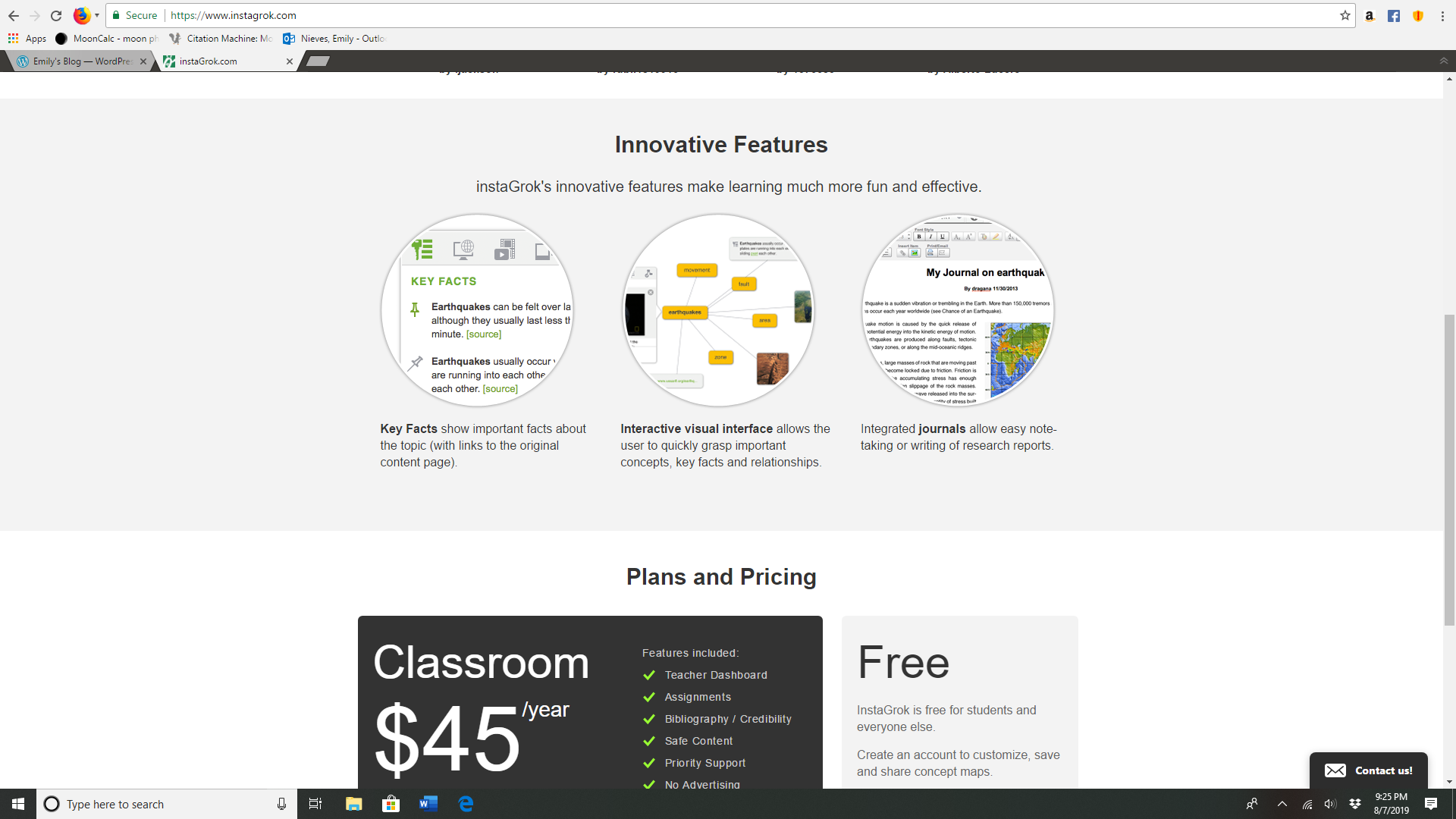

These three technologies produce instructional materials for use in a lesson and they each walk you through anything you may like or find interesting. The website is easy to get to and easy to get around to find what you are looking for your classroom.
Some educators perceive teaching as an art which practiced by individuals who are born with intuitive awareness, whereas others view teaching as a science that practiced by in a scientific manner. Whilst, others in the opinion that teaching as both an art and a science. Is teaching an art, a science or a combination of both elements? In the light of this issue, the argument is about whether teaching is an activity involving general laws or principles as well as scientific terms to facilitate planning; or whether it is an individualistic, intuitive and spontaneous process to produce creative work as it involves so many factors which are impossible to specify general lines of direction; or whether it involves both art and science.
In my opinion teaching involves both – art and science. There are three basic important principles in education which are aim (goal and objective), mean (process or method) and end (evaluation and assessment). Aim of education involves the science of teaching where observable and measurable goals and objectives are developed. The goals and objectives will be stated specifically and clearly based on the students’ ability. Mean of education may involve both – the art and science of teaching.The process or method of teaching is planned by teachers accordingly – this is where teaching is regarded as a science, and teacher will be using different approach for different type of classes or different students. At this stage, teachers will use their own experience and creativity to deliver knowledge and to make the students understand by using their personalized knowledge – this is where teaching is regarded as an art. Likewise, end of education may involve both elements – science and art. At this stage, teacher will identify a suitable assessment to evaluate the students’ understanding which can measure the students’ different ability. Teaching will be evaluated based on students’ achievement on the assessment.
The  three featured "Priorities" i enjoyed reviewing.
The first one on my list would be Higher Education priority because Technology is rapidly transforming the way we live, learn, and work. New jobs are emerging as others are lost to automation. People are living longer, yet switching jobs more often. These dramatic shifts call for a re-imaging  of the way we prepare for work and life—specifically, how we learn new skills and adapt to a changing economic landscape.  These partnerships will allow students—particularly low-income students—to access federal student aid for the first time to enroll in programs offered by non-traditional training providers, in partnership with colleges and universities, including coding boot camps, online courses, and employer organizations.
The second one would be Equity  Equality is important because it is the foundation of any fair society where each member has the opportunity to reach his full potential. Equality prevents any section of a society from dominating other sections in processes such as community capacity building.
Lastly, Privacy New education technologies often raise questions about how best to protect student privacy during use. It presents some requirements and best practices to consider when evaluating the use of online educational services. It gives you a sense of trust and loyalty to what you information you share. Provides timely information and updated guidance on privacy, confidentiality, and security practices through a variety of resources, including training materials and opportunities to receive direct assistance with privacy, security, and confidentiality of student data systems.  Data access, be it in person, over the phone, by mail, or electronically.

 data access, be it in person, over the phone, by mail, or electronically. The  three featured "Priorities" i enjoyed reviewing.
The first one on my list would be Higher Education priority because Technology is rapidly transforming the way we live, learn, and work. New jobs are emerging as others are lost to automation. People are living longer, yet switching jobs more often. These dramatic shifts call for a re-imaging  of the way we prepare for work and life—specifically, how we learn new skills and adapt to a changing economic landscape.  These partnerships will allow students—particularly low-income students—to access federal student aid for the first time to enroll in programs offered by non-traditional training providers, in partnership with colleges and universities, including coding boot camps, online courses, and employer organizations.
The second one would be Equity  Equality is important because it is the foundation of any fair society where each member has the opportunity to reach his full potential. Equality prevents any section of a society from dominating other sections in processes such as community capacity building.
Lastly, Privacy New education technologies often raise questions about how best to protect student privacy during use. It presents some requirements and best practices to consider when evaluating the use of online educational services. It gives you a sense of trust and loyalty to what you information you share. Provides timely information and updated guidance on privacy, confidentiality, and security practices through a variety of resources, including training materials and opportunities to receive direct assistance with privacy, security, and confidentiality of student data systems.
 Emily's Blog